
Uncategorized
In the dynamic world of trading, where markets fluctuate and opportunities arise, one concept stands out as a cornerstone of success: the risk-reward ratio. Whether you’re trading stocks, forex, or cryptocurrencies, understanding What is the Risk Reward Ratio in Trading can transform your approach to managing capital and achieving consistent profitability. This ratio measures the potential profit you aim to gain against the risk you’re willing to take, serving as a guiding metric for informed decision-making.
For beginners, it’s a foundational tool to protect capital; for seasoned traders, it’s a strategic lever to optimize performance. Unlike general discussions on risk and return, this article dives deep into the practical application of the risk-reward ratio, offering step-by-step guidance, real-world examples, and actionable strategies. By mastering how to calculate risk reward ratio and integrating it into your trading plan, you can reduce emotional decisions, enhance long-term profitability, and safeguard your investments. Whether you’re a novice trader or a seasoned investor, this comprehensive guide will empower you to leverage the importance of risk reward ratio in trading to achieve your financial goals with confidence and precision.
What is the Risk Reward Ratio in Trading?
The risk-reward ratio is a fundamental metric in trading that quantifies the potential reward of a trade relative to its risk. Expressed as a ratio (e.g., 1:2), it compares the amount you’re willing to lose if the trade goes wrong (risk) to the potential profit if the trade succeeds (reward). For example, a 1:2 ratio means you risk $1 to potentially gain $2. This concept is distinct from general risk and return discussions, as it focuses specifically on individual trades, providing a clear framework for decision-making.Unlike broader risk concepts, the risk-reward ratio is actionable, enabling traders to evaluate whether a trade is worth taking.
It’s a critical tool across markets like forex, stocks, and cryptocurrencies, helping traders align their strategies with their risk tolerance and profit goals. By defining what is a good risk to reward ratio in trading, traders can filter opportunities, ensuring they only pursue trades with favorable outcomes. This section sets the stage for understanding how to calculate risk reward ratio and applying it effectively, making it an essential skill for anyone aiming to succeed in trading.
Why the Risk Reward Ratio is Critical for Trading Success
The risk-reward ratio is more than a number—it’s a strategic tool that shapes every aspect of trading. Here’s why it’s indispensable:
Protecting Your Capital
A well-defined risk-reward ratio acts as a shield against catastrophic losses. By setting a clear limit on potential losses (via stop-loss orders), traders ensure that no single trade wipes out their account. For instance, risking only 1% of your capital per trade with a 1:3 ratio keeps losses manageable while aiming for substantial gains.
Boosting Long-Term Profitability
Even with a low win rate, a favorable risk-reward ratio can lead to profitability. For example, a trader with a 30% win rate can still profit if their average winning trade yields three times the loss of a losing trade. This principle underscores the importance of risk reward ratio in trading for sustainable success.
Enabling Informed Decision-Making
The ratio helps traders evaluate trades objectively. By comparing potential rewards to risks, you can prioritize high-probability setups, avoiding trades with poor risk-reward profiles.
Supporting Trading Psychology
A structured risk-reward ratio reduces emotional decision-making. Knowing your risk and reward upfront fosters discipline, helping you stick to your plan and avoid impulsive moves.
How to Calculate the Risk Reward Ratio: A Step-by-Step Guide with Practical Examples
Calculating the risk-reward ratio is straightforward but requires precision to ensure it aligns with your trading strategy. Below is an expanded step-by-step guide, enriched with detailed examples across different markets (stocks, forex, and cryptocurrencies) and additional insights to help traders apply this concept effectively.
You can also read Free Forex Trading Bot for better results in forex trading.
Step 1: Identify the Risk (Stop-Loss)
The risk is the amount you’re willing to lose if the trade moves against you. This is determined by setting a stop-loss, a price level where you exit the trade to limit losses. The stop-loss should be based on technical analysis (e.g., support levels, moving averages) or fundamental factors (e.g., key news events). A well-placed stop-loss reflects market structure, avoiding arbitrary levels that could lead to premature exits.
Example in Stocks: You buy Apple (AAPL) at $150, with a support level at $145 based on a 50-day moving average. Your stop-loss is set at $145, making the risk per share $150 – $145 = $5.
Example in Forex: Trading GBP/USD at 1.3000, you identify a support level at 1.2950 based on a trendline. Your stop-loss is at 1.2950, risking 50 pips.
Example in Crypto: Buying Bitcoin (BTC) at $60,000, you set a stop-loss at $58,000, a key support from a previous low. The risk is $2,000 per BTC.
Step 2: Identify the Reward (Take-Profit)
The reward is the potential profit, determined by setting a take-profit level where you exit to lock in gains. This should be realistic, based on resistance levels, Fibonacci retracements, or price targets derived from historical patterns. Setting an overly ambitious take-profit can skew the ratio unrealistically, while a conservative target may limit profitability.
Example in Stocks: For AAPL, you identify a resistance level at $160 based on prior highs. Your take-profit is set at $160, making the reward $160 – $150 = $10.
Example in Forex: For GBP/USD, you target a resistance at 1.3150 (150 pips above entry). The reward is 150 pips.
Example in Crypto: For BTC, you target $64,000, a resistance level from a recent high. The reward is $64,000 – $60,000 = $4,000.
Step 3: Calculate the Ratio
Divide the reward by the risk to get the risk-reward ratio.
Formula: Risk-Reward Ratio = (Take-Profit – Entry Price) / (Entry Price – Stop-Loss)
Stock Example Calculation: ($160 – $150) / ($150 – $145) = $10 / $5 = 2. The ratio is 1:2.
Forex Example Calculation: 150 pips / 50 pips = 1:3.
Crypto Example Calculation: $4,000 / $2,000 = 1:2.
Practical Application Across Markets
To illustrate, consider a diversified trading portfolio:
| Market | Asset | Entry Price | Stop-Loss | Take-Profit | Risk | Reward | Risk-Reward Ratio |
| Stocks | AAPL | $150 | $145 | $160 | $5 | $10 | 1:2 |
| Forex | GBP/USD | 1.3000 | 1.2950 | 1.3150 | 50 pips | 150 pips | 1:3 |
| Crypto | BTC | $60,000 | $58,000 | $64,000 | $2,000 | $4,000 | 1:2 |
Additional Considerations
- Adjusting for Volatility: In volatile markets like crypto, wider stop-losses may be necessary, potentially lowering the ratio unless the reward is proportionally higher.
- Broker Fees and Spreads: Account for transaction costs, as they reduce the effective reward. For example, a $10 spread in forex reduces the reward by 10 pips.
- Timeframe Impact: Short-term traders (e.g., day traders) may use tighter ratios (1:1.5), while swing traders aim for higher ratios (1:3) due to longer holding periods.
This expanded section provides a robust framework for calculating the risk-reward ratio, ensuring traders can apply it across diverse markets with confidence.
What is a Good Risk to Reward Ratio in Trading?
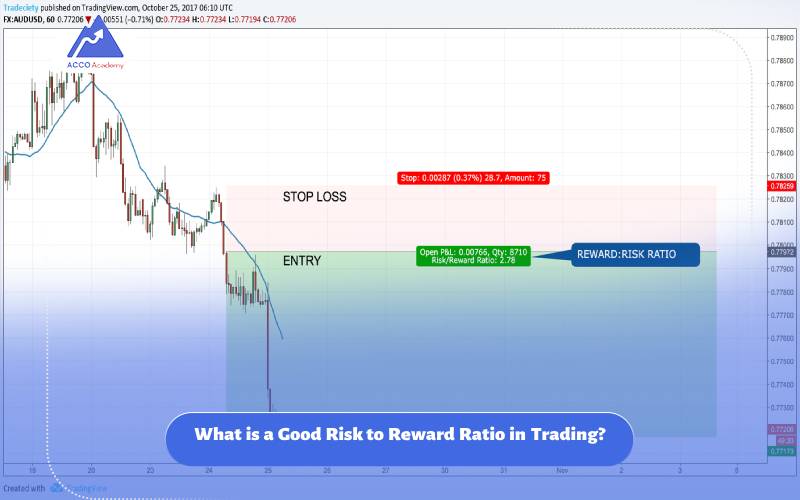
Determining what is a good risk to reward ratio in trading depends on your trading style, market conditions, win rate, and risk tolerance. This section is expanded to include deeper analysis, practical scenarios, and a new table to guide traders in selecting optimal ratios.
Common Risk-Reward Ratios and Their Implications
- 1:1 Ratio: Risk equals reward. Suitable for high win-rate strategies (e.g., 70%+), such as scalping in low-volatility markets. However, it offers limited profitability and requires consistent wins.
- 1:2 Ratio: Risk $1 to gain $2. A balanced choice for many traders, offering a good mix of risk control and profit potential. Common in swing trading or forex.
- 1:3 or Higher: Ideal for strategies with lower win rates (e.g., 30-40%), maximizing profitability per winning trade. Common in trend-following or crypto trading.
Factors Influencing a “Good” Ratio
- Win Rate: The percentage of winning trades directly impacts the ideal ratio. A 60% win rate may allow a 1:1 ratio, while a 30% win rate requires at least 1:3 to ensure profitability. Use this formula:
Expected Profitability = Win Rate × Reward – (1 – Win Rate) × Risk - Market Volatility: Volatile markets (e.g., crypto) may demand higher ratios to justify larger price swings, while stable markets (e.g., blue-chip stocks) allow lower ratios.
- Trading Style: Day traders may prefer 1:1.5 to 1:2 due to frequent trades, while swing traders aim for 1:3 or higher to capitalize on larger moves.
- Risk Tolerance: Conservative traders may opt for higher ratios (1:4) to minimize exposure, while aggressive traders may accept 1:1.5 for faster-paced strategies.
Scenario Analysis
Consider two traders with different win rates:
- Trader A: 60% win rate, 1:1 ratio. For 100 trades, 60 wins yield $60,000 (60 × $1,000), and 40 losses cost $40,000 (40 × $1,000). Net profit: $20,000.
- Trader B: 30% win rate, 1:3 ratio. For 100 trades, 30 wins yield $90,000 (30 × $3,000), and 70 losses cost $70,000 (70 × $1,000). Net profit: $20,000.
This demonstrates that a higher risk-reward ratio can compensate for a lower win rate, making it a versatile tool.
Optimal Ratios by Market and Strategy
| Trading Style | Market | Recommended Ratio | Win Rate Needed | Use Case |
| Scalping | Forex | 1:1 to 1:1.5 | 60-70% | High-frequency, low-risk trades |
| Day Trading | Stocks | 1:2 | 50-60% | Balanced risk and reward |
| Swing Trading | Crypto | 1:3 or higher | 30-40% | Larger price movements |
| Long-Term | ETFs | 1:4 | 25-35% | Conservative, high-reward setups |
Practical Tips for Choosing a Ratio
- Test Your Strategy: Backtest your trading plan to find the optimal ratio for your win rate and market.
- Adapt to Market Conditions: In trending markets, higher ratios (1:3) may be achievable; in range-bound markets, lower ratios (1:1.5) may suffice.
- Balance with Other Metrics: Combine the ratio with position sizing and risk per trade (e.g., 1-2% of capital) for a holistic approach.
By aligning the risk-reward ratio with your strategy and market dynamics, you can optimize profitability while managing risk effectively.
Integrating the Risk Reward Ratio into Your Trading Strategy
To fully leverage the importance of risk reward ratio in trading, integrate it into your trading plan with precision. This expanded section includes additional strategies, tools, and real-world applications to ensure traders can implement the ratio effectively.
Position Sizing for Optimal Risk Management
Position sizing determines how much capital to allocate per trade based on the risk-reward ratio and risk tolerance. Risk only a small percentage (e.g., 1-2%) of your account per trade to protect against drawdowns.
Example: With a $10,000 account and a 1% risk ($100), a trade with a $5 risk per share (stop-loss) allows you to buy 20 shares ($100 ÷ $5). If the risk-reward ratio is 1:3, the potential reward is $300 (20 shares × $15).
Formula: Position Size = (Account Risk) ÷ (Risk per Unit)
Filtering High-Potential Trades
Use the risk-reward ratio to prioritize trades with favorable profiles. For example, in forex, only take trades with at least a 1:2 ratio unless your win rate exceeds 60%. Tools like TradingView can help visualize support/resistance levels to set realistic stop-loss and take-profit points.
Practical Tip: Create a checklist for trade setups, requiring a minimum risk-reward ratio (e.g., 1:2) before entering. This filters out low-probability trades.
Maintaining Trading Discipline and Psychology
A predefined risk-reward ratio fosters discipline by providing a clear plan. For instance, knowing you’re risking $100 to gain $300 reduces the temptation to adjust stop-losses mid-trade. To enhance trading psychology risk reward:
- Journal Your Trades: Record entry, stop-loss, take-profit, and ratio for each trade to track performance.
- Use Automation: Set stop-loss and take-profit orders on platforms like MetaTrader to avoid emotional interference.
- Practice Patience: Wait for setups that meet your ratio criteria, avoiding overtrading.
Advanced Integration Techniques
- Combining with Technical Indicators: Use indicators like RSI or Bollinger Bands to confirm stop-loss and take-profit levels, ensuring they align with your ratio.
- Dynamic Ratios: Adjust ratios based on market conditions. For example, in a volatile crypto market, aim for 1:4 to account for larger swings.
- Portfolio Diversification: Apply different ratios across asset classes (e.g., 1:2 for stocks, 1:3 for forex) to balance risk.
| Strategy Component | Role of Risk-Reward Ratio | Example Application |
| Position Sizing | Determines trade size | Risk 1% of $10,000 for a 1:3 trade |
| Trade Filtering | Selects high-potential trades | Only enter trades with 1:2+ ratio |
| Discipline | Reduces emotional decisions | Pre-set stop-loss/take-profit levels |
This approach ensures the risk-reward ratio is a cornerstone of your trading strategy, maximizing efficiency and consistency.
Common Mistakes to Avoid with the Risk Reward Ratio
Even with a solid understanding of how to calculate risk reward ratio, traders can falter. Avoid these pitfalls:
- Ignoring Win Rate: A high ratio is useless without a realistic win rate.
- Unrealistic Stop-Loss/Take-Profit: Setting levels too tight or too wide distorts the ratio.
- Frequent Adjustments: Moving stop-loss or take-profit mid-trade undermines discipline.
- Lack of a Risk Management Plan: Failing to integrate the ratio into a broader strategy leads to inconsistent results.
Key Takeaways: Turning the Risk Reward Ratio into Your Trading Superpower
The risk-reward ratio is a powerful tool that transforms trading from guesswork to a disciplined, profitable endeavor. By understanding What is the Risk Reward Ratio in Trading, calculating it accurately, and integrating it into your strategy, you protect your capital, boost profitability, and make informed decisions. This guide has covered how to calculate risk reward ratio, what is a good risk to reward ratio in trading, and practical applications across markets like stocks, forex, and crypto.
We’ve explored position sizing, trade filtering, and psychological benefits, with examples showing how a 1:3 ratio can yield profits even with a 30% win rate. Avoiding common mistakes, such as unrealistic stop-losses or ignoring win rates, ensures long-term success. Start applying the risk-reward ratio today to filter trades, manage risk management in trading strategies, and achieve consistent results. Take control of your trading journey—calculate your ratios, stick to your plan, and watch your performance soar.
Frequently Asked Questions: Unraveling the Risk Reward Ratio
- What’s the difference between the risk-reward ratio and win rate, and how do they work together?
The risk-reward ratio measures potential profit against risk per trade, while win rate is the percentage of winning trades. They work together to determine profitability. A high win rate allows lower ratios (e.g., 1:1), while a lower win rate requires higher ratios (e.g., 1:3) to stay profitable. - Can I use a fixed risk-reward ratio for all trades, regardless of market or timeframe?
No, a fixed ratio may not suit all markets or timeframes. Volatile markets like crypto may require higher ratios (e.g., 1:3), while stable markets may allow 1:2. Adjust based on market conditions and your strategy. - How does the risk-reward ratio help with trading psychology?
It provides a clear plan, reducing emotional decisions. Knowing your risk and reward upfront fosters discipline and confidence, minimizing stress during market fluctuations. - Is a 1:1 risk-reward ratio ever acceptable?
Yes, in high win-rate strategies (e.g., 70%+), a 1:1 ratio can be profitable, especially in scalping or low-volatility markets. - How often should I review my risk-reward ratio strategy?
Review it quarterly or after significant market changes. Adjust based on performance metrics like win rate and market conditions. - Does market type (volatile vs. stable) affect the optimal risk-reward ratio?
Yes, volatile markets require higher ratios to account for larger price swings, while stable markets may allow lower ratios due to predictable movements.